. Born on October 31, 2005, at the Ruber International Hospital in Madrid, Leonor was granted the traditional titles of the heir to the Spanish crown upon her father’s ascension in 2014: Princess of Asturias, Princess of Girona, Princess of Viana, Duchess of Montblanc, Countess of Cervera, and Lady of Balaguer . Her path to the throne represents not just a generational shift, but a powerful symbol of continuity and modernization for the Spanish monarchy, which was restored in 1975 after the Franco dictatorship under her grandfather, King Juan Carlos I .
The foundation of Leonor’s royal preparation has been a world-class education, carefully curated to balance tradition with global perspective. She began her studies at Santa María de los Rosales School in Madrid, the same institution her father attended, before pursuing an International Baccalaureate at UWC Atlantic College in the Vale of Glamorgan, Wales . This prestigious institution, known for producing global leaders, placed her among students from diverse backgrounds, including refugees and scholarship recipients, offering her first taste of life outside the royal bubble . Her mother, Queen Letizia, a former journalist, has been instrumental in supervising her academic progress and imparting knowledge of Spanish history and family legacy . Today, Leonor is fluent in Spanish, Catalan, English, and French, with additional studies in Arabic and Mandarin .
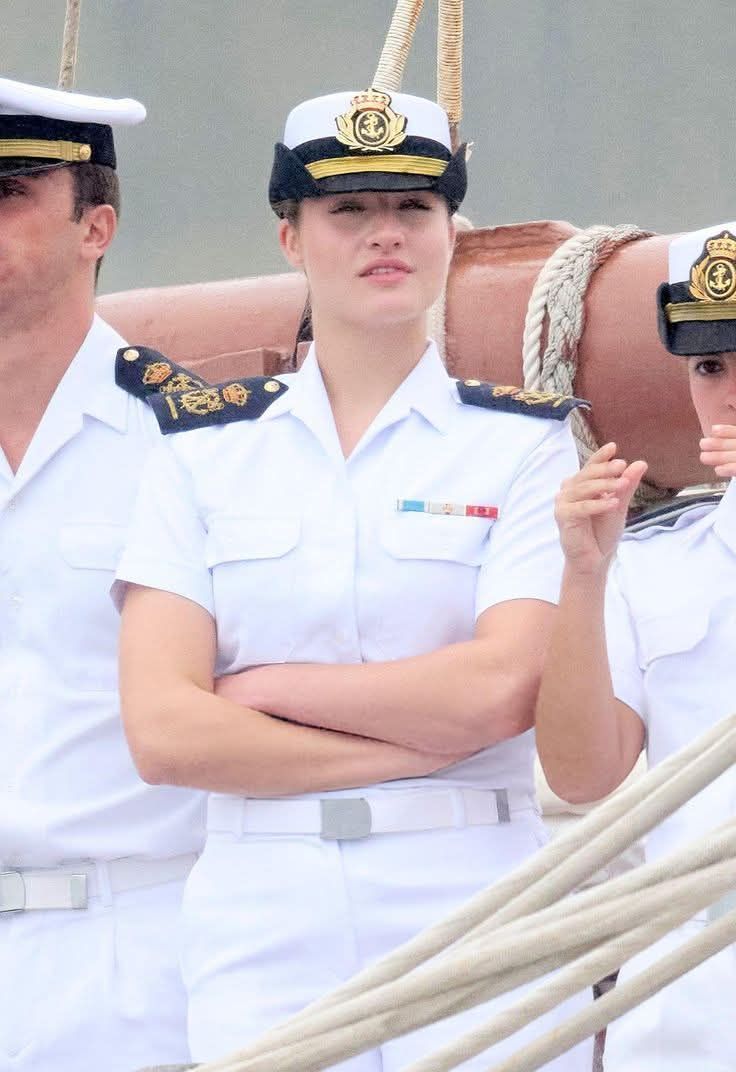
Spanish law requires the heir to the throne to complete military training across the Army, Navy, and Air Force to prepare for the role of Commander-in-Chief. Leonor began this rigorous journey in August 2023 at the General Military Academy in Zaragoza, training alongside approximately 560 cadets . There, she learned to handle firearms, underwent physical conditioning, and swore an oath of allegiance to the Spanish flag on October 7, 2023, in a ceremony attended by her parents . In 2024, she transitioned to naval training at the Naval Military School in Marín, Galicia, where she embarked on a 140-day, 17,000-mile voyage aboard the training ship Juan Sebastián de Elcano, serving as a regular crew member . She later trained on the warship Blas de Lezo, participating in live-fire naval maneuvers .
Perhaps her most dramatic achievement came in December 2025, when Leonor completed her first solo flight in a Pilatus PC-21 aircraft at the General Air and Space Academy in San Javier, Murcia . This milestone made her the first female member of the Spanish royal family to fly solo, earning her the affectionate nickname “Spain’s Top Gun Princess” from the press . She received a ceremonial welcome upon arrival at the academy and is now in her final year of air force training, expected to graduate in June 2026 . Her accomplishments have been formally recognized: she was awarded the Grand Cross of Military Merit and the Grand Cross of Naval Merit by her father, and the Region of Murcia has announced plans to present her with its Gold Medal, the highest regional honor .
The year 2026 is shaping up to be pivotal for the princess. Upon completing her air force training in June, she will transition to civilian life and begin her university education, likely following in her father’s footsteps with studies in Law and International Relations at a public university in Madrid . Her father, King Felipe VI, earned his law degree from the Universidad Autónoma de Madrid and completed a master’s at Georgetown University in Washington, D.C. . While her younger sister, Infanta Sofía, has chosen to study Political Science abroad through the Forward College program in Lisbon, Paris, and Berlin, Leonor is expected to remain in Spain for her higher education . Her curriculum will likely emphasize constitutional law and the functioning of the European system, essential knowledge for a future head of state .
Public appearances have showcased Leonor’s growing confidence and her evolving role within the monarchy. On January 6, 2026, she joined her parents at the Royal Palace in Madrid for the Military Easter celebration, the solemn event that inaugurates the royal family’s annual institutional agenda . Wearing a blue military uniform adorned with the pale blue sash of the Royal and Distinguished Spanish Order of Charles III, she balanced her formal attire with shimmery pink eyeshadow and a braided bun, offering a subtle glimpse of her Gen Z personality . Her father publicly honored her, stating: “I know, Leonor, that your experiences of these past few years are helping you to understand and fully embrace the commitment and sense of duty that are the moral compass of military life” . In a significant moment during the same ceremony, the King referred to her directly as the future “Queen of Spain” .
As she prepares for university, speculation surrounds her next steps on the international stage. Unlike other European princesses her age, Leonor has yet to wear a tiara or attend a state banquet in formal evening gown—a “coming out” moment that royal watchers eagerly anticipate . She has already represented the Crown abroad, making her first official solo trip to Portugal in July 2024 . Her institutional responsibilities continue to expand, including presiding over the Princess of Asturias Awards and delivering speeches on behalf of the Royal Household . In a European royal landscape marked by scandals and abdications, Princess Leonor stands out for her “sense of duty and quiet confidence” . When she eventually ascends to the throne, she will not merely inherit a crown; she will embody the hopes of a modern, democratic Spain, ready to write the next chapter of Bourbon history with a distinctly Gen Z voice .